Facilities
|
Facilities
Written by Haven Liu
Thursday, 01 April 2010 23:49
|
|
|
|
|
The laboratory is equipped to study the flow behavior of polymeric fluids, separation processes using membranes and polymeric resins, and polymer/solid interfaces. Major Instrumentations
Mini-Mobile-Modular (M3) RO Desalting System: Overview: The Mino-Mobile-Modular (M3) RO desalting system is a pilot-scale spiral-wound RO membrane system capable of treating brackish water and seawater. The M3 system is a mobile research platform that be easily transported by a pickup truck, and the system is designed such that that it has separate modules for pretreatment, RO desalination, and post treatment. The M3 system can produce fresh water at approximately 1.5 to 5 gallons per minutes and operated under feed pressures of up to 1,000 psi. Recently, the M3 system has been employed both in laboratory and in the field for various studies, such as testing novel technologies for water treatment, water quality sensing, process control and monitoring, and membrane integrity monitoring. Components: The M3 system consists of four major components: a pretreatment system, RO water production system, online sensors on the system, and data acquisitions/storage system. Water from the feed tank (or directly from a feed line) is pumped through two sets of cartridge filters by low-pressure positive displacement pumps in order to remove solid particles and contaminants down to below the micron range. Water exiting the pretreatment module enters high-pressure pumps controlled by variable frequency drives (VFDs). The direction of the feed water can be controlled by solenoid valves network. There are six 2.5 inch x 40 inch spiral-wound membrane modules arranged in series. An actuated valve is located on the retentate stream to control the retentate flow rate and pressure inside the RO pressure vessels. The M3 system is equipped with online sensors for flow rate, fluid conductivity, pH, turbidity, and stream pressure, as well as automatic controllers for water recovery, flow rate, and pressure. In addition, the M3 system includes advanced model-based control, remote monitoring (wireless and via the web), web-based data storage, monitoring server and web-based video/audio monitoring.
Pulsed Marker Membrane Integrity Monitoring (PM-MIMo) system: Overview: The Pulsed Marker Membrane Integrity Monitoring (PM-MIMo) system is primarily used for real-time and high-sensitivity monitoring of reverse osmosis (RO) membrane integrity. The PM-MIMo approach involves pulsed dosing of a fluorescent marker into RO feed stream, coupled with online monitoring of marker concentration in RO permeate stream. The PM-MIMo system is fully automated and controlled via computer interface. The PM-MIMo system is specifically designed such that it is mobile and can be easily integrated into RO desalting systems of various scales and configurations. Components: The PM-MIMo system consists of continuous flow metering pump and spectroflurometer system. The metering pump is used to inject marker into RO feed stream. It is controlled via computer interface and its output can be varied in pulse magnitude, duration, and characteristics. The spectroflurometer system is used for real-time and high-sensitivity quantification of fluorescent marker concentration in RO permeate stream. It consists of LED light source, optical transmission filters, optical fibers, fluorescence flow cell (where the RO permeate stream is allowed to flow through), and spectrometer (where fluorescence intensity is correlated to marker concentration).
Membrane Monitor (MeMo) System: Overview: The MeMo system is used for membrane diagnostics particularly focused on detection of mineral scaling and other fouling on the membrane surface. Primarily used with RO membranes, it can also be used with other flat-sheet membranes. The MeMo system is fully automated and can be controlled manually or via computer interface. Components: A high-pressure positive displacement pump delivers water from the feed tank (or directly from a feed line) into the high-pressure MeMo RO cell, which is equipped for viewing of the membrane surface contained within. A compact, high-resolution microscope inside the MeMo module enables real-time monitoring of surface changes via direct observation of the membrane surface. The MeMo is also equipped with sensors for conductivity, pressure and flow rates of the RO feed, concentrate, and permeate streams. The pressure and flow rate are regulated using an automated control valve as well as a variable frequency drive (VFD) linked to the pump. Lastly the MeMo contains optional cartridge filtration modules as well as a precision metering pump for dosing the feed stream with antiscalant or other chemicals.
2nd Generation Compact Modular Reverse Osmosis (Com2RO): Overview: The 2nd generation Compact Modular Reverse Osmosis (Com2RO) system is a highly flexible advanced UF-RO testing platform featuring novel operational capabilities designed specifically for field and ship board testing. These capabilities include self-adaptive UF filtration/ backwashing strategies with flexible selections of backwash source water, and novel tankless design to reduce system footprint. The maximum production capacity of the system is 18,000 GPD (at 35% RO product water recovery). Components: The major components of the Com2RO system include a low pressure pump, a self-cleaning pre-filter (200 micron) for coarse particle, three UF modules connected in parallel (inside out filtration configuration using polyethersulfone multibore UF membranes with 0.02 μm nominal pore size), a high pressure positive displacement pump, and three 8" RO elements in series. The Com2RO system is equipped variable frequency drives for precise pump speed control, electric-actuated motorized valves and valve manifolds for highly flexible directional flow control and precise RO back-pressure control, and an assortment of online sensors for comprehensive flow, pressure, conductivity, and temperature measurements. The UF and RO units are on separate skids to allow easy reconfiguration of UF-RO system integration, standalone unit operation, as well as augmentation with additional units.
Computational Cluster: The computational cluster is consisted of 16 servers, include 2 management nodes, 12 computational nodes, and 2 storage node (one of which is at an remote location for offsite backup). The cluster has 200 CPUs, 268GB RAM, and 36TB of raw storage space. The cluster is housed in a temperature and humidity controlled space in the Boelter Hall. The Linux based cluster is built with the Rocks Cluster, using the Oracle Grid Engine batch-queuing system. The cluster hosts various computational tools and simulators (e.g., analysis of high throughput toxicity data, nanoparticle agglomeration simulatiors, environmental impact analysis, life-cycle analysis, image analysis, etc.), and is managed and its performance monitored continuously via an array of open source infrastructure monitoring utilities such as Ganglia, Nagios, OpenIPMI, etc. Various compilers (e.g. C, C++, Python) as well as computing environments (e.g. MATLAB, R, Java) are also running on the cluster.
Dynamic Light Scattering: The Malvern Zetasizer Nano S90 measured particle sizes in the range of 0.3nm to 5 μm and molecular weight measurements down to 9,800Da via a 90 degree scattering laser with a wavelength of 633nm.
Coulter Counter: The Beckman Coulter Multisizer 3 Coulter Counter Particle Analyzer is used for quantifying particle number, volume, mass, and surface area size distributions in one measurement via the Coulter principle (also known as electrical sensing zone method). The overall sizing range is 0.4 µm to 1,200 µm. Its response is unaffected by particle color, shape, composition or refractive index.
Contact Angle: The Kruss FM40 EasyDrop Contact Angle system is used to measure the angle where a liquid/vapor interface meets a solid surface. It quantifies the wettability of a solid surface by a liquid via the Young equation.
Atomic Force Microscopy: The Atomic Force Microscopy or AFM is a very high-resolution type of scanning probe microscopy, with demonstrated resolution on the order of fractions of a nanometer, more than 1000 times better than the optical diffraction limit. It is typically used to determine the surface topology of a given sample.
Atmospheric Pressure Plasma: The Surfx Technologies Atomflo Atmospheric Pressure Plasma system produces a plasma at the pressure of the surrounding atmosphere.
Gas Chromatograph: The Hewlett Packard 5890 Gas Chromatograph (GC) is used to separate and analyze compounds that can be vaporized without decomposition. Typical uses of GC include testing the purity of a particular substance, or separating the different components of a mixture (the relative amounts of such components can also be determined). In some situations, GC may help in identifying a compound.
Fourier Transform Infrared Spectrometer: A SRI 8610C Gas Chromatograph Fourier Transform Infrared Spectrometer (FTIR) simultaneously collects spectral data (absorption, emission, photoconductivity or Raman scattering of a solid, liquid or gas) in a wide spectral range.
Thermogravimetric Analysis: Bio-rad fts-40 TGA/IR, Perkin-Elmer System 4 Thermal Analysis Microprocessor Controller. Thermogravimetric analysis (TGA) is a method of thermal analysis in which changes in physical and chemical properties of materials are measured as a function of increasing temperature (with constant heating rate), or as a function of time (with constant temperature and/or constant mass loss).
UV-Vis: The Hewlett Packard 8452A diode array ultraviolet–visible spectrometer or spectrophotometer (UV-Vis or UV/Vis) measures the absorption spectroscopy of a given liquid sample in the ultraviolet-visible spectral region. The UV-VIS can detect wavelengths range between 190nm and 510nm. It collects up to ten scans per second. The system program can handle data from extracting fixed wavelength kinetic traces to fitting the 3D files to selected kinetic equations. The UV/VIS utilizes single, collimated (parallel) beam that allows flexibility in the selection of cuvettes and accessories. The diode array detector allows simultaneous, access to all wavelength information. It has a low-noise lamp, low radio frequency interference (RFI) and high electrostatic discharge immunity.
Total Organic Carbon Analyzer: The Aurora 1030D is equipped to perform both heated persulfate wet oxidation and high temperature combustion techniques on the same instrument. Both wet oxidation and combustion modes process aqueous samples for analysis of the total organic carbon (TOC), total inorganic carbon (TIC), and non-purgeable organic carbon (NPOC) content of the samples. The detection range for the persulfate wet oxidation method is between 2 ppb to 30,000 ppm of organic carbon; while the detection range for the combustion method is 100 ppb - 30,000 ppm of organic carbon. The Aurora 1030D supports USEPA-approved methods, Standard Methods, ASTM, DIN/ISO/CEN, and EU Methods. Depending upon the protocol employed, up to 300 samples per 24-hour period can be analyzed, and in excess of 100,000 samples per year. The Aurora 1030D Dual Oxidation Mode TOC Analyzer is equipped with the 1088 Rotary Autosampler. The 1088 autosampler aspirates liquid samples from vials and transfers each sample aliquot to an Aurora 1030D TOC analyzer for analysis. A removable 88-position autosampler tray loads the sample vials for fully automated, unattended operation. The 1088 supports a number of special functions to address a range of sample conditions and analysis requirements. Onboard magnetic stirring ensures samples containing insoluble components or particles are homogeneous for sampling and accurate analysis. Septum piercing provides closed vial sampling for applications where open vials may comprise the accuracy of measurements. System configuration for sample pretreatment allows pre-acidification and purging of samples within the 1088 prior to sampling. This technique removes the TIC content of samples, reducing the analysis time required for TOC measurements.
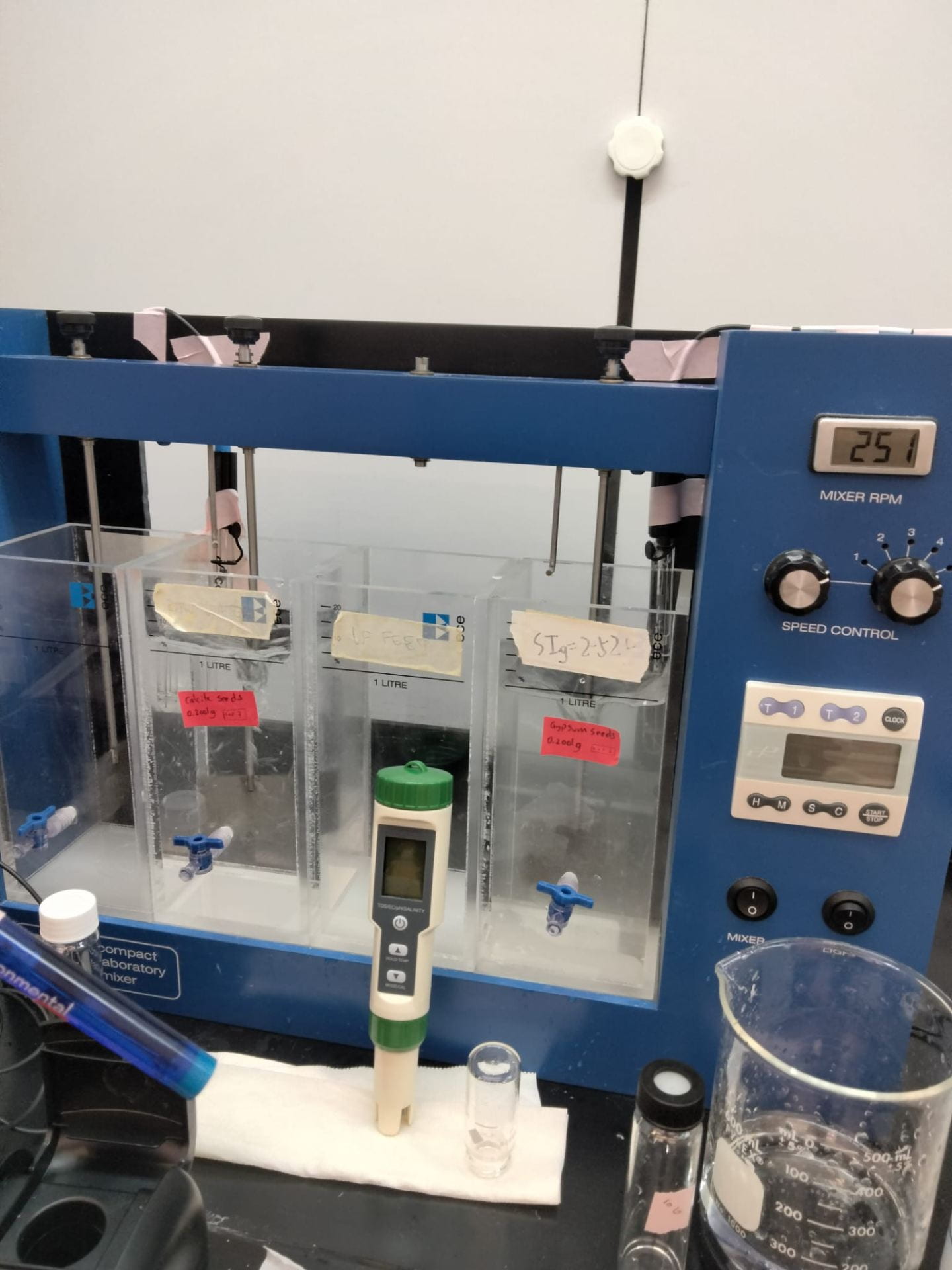
Batch Precipitation System: A Batch Precipitation System with batch reactor cells and on-line pH and calcium ion probes is used for studying various precipitation processes for RO feed water pretreatment or RO concentrate treatment. The adjustable agitator enables a wide range of mixing from rapid to slow gentle mixing. Real time measurement of pH and calcium activity via a computerized system, coupled with multi-electrolyte ion analysis (OLI Analyzer), enable s real time monitoring of coupled calcium carbonate and calcium sulfate precipitation. |
| Last Updated ( Wednesday, 13 March 2013 21:02 ) |